A recent New York Times article by Adam Liptak posed a wonderful question for budding free-speech theorists like myself. He inquires, "What role should the First Amendment play when foreigners are doing the talking and the topic may be terror?"
GENERAL ARGUMENT
Using framer's intent makes for an interesting argument. I submit that since the framers did not give equal rights to all citizens, we cannot claim that they intended to give equal rights to non-citizens. When the 14th Amendment expanded the application of the Bill of Rights, it specifically referred to citizens, except in the "due process clause," where the Amendment reads, "nor shall any State deprive any person of life, liberty, or property, without due process of law; nor deny to any person within its jurisdiction the equal protection of the laws." And, as the court decided in Gitlow v. New York, the "freedom of speech and of the press-which are protected by the First Amendment from abridgment by Congress-are among the fundamental personal rights and 'liberties' protected by the due process clause of the Fourteenth Amendment from impairment by the States." The Amendment itself claims to protect "persons" and not just citizens, so the barest reading of the Constitution would lead us to believe that aliens receive the same free speech rights as citizens.
CASES
But that is only half of the question. What if the security of our nation is threatened by the speech in question? I can reword that: is speech that endorses terrorism one of the risks that necessarily accompanies freedom of speech? Liptak gave two examples to work with. The first case clearly illustrates the different form restrictions on foreigners can take. It is not about someone in the United States being prosecuted; it is about the someone being denied legal entry into the States. In 2004, a Swiss Muslim philosopher named Tariq Ramadan was denied a visa. The government explained (page 6) that because of "material support Ramadan provided to undesignated terrorist organizations," he was not eligible for entry. Ramadan's case has been taken up by several institutions, notably the ACLU, who see it as an example of improper ideological exclusion. Unfortunately, and despite Liptak and the ACLU's efforts to paint the case otherwise, it is impossible to see this as being a free speech case. In the filing for the suit, Ramadan's defense claims that "the revocation was based on section 411(a)(1)(A)(iii) of the USA PATRIOT Act." This section says that a visa may be revoked if the alien "has used [his] position of prominence within any country to endorse or espouse terrorist activity, or to persuade others to support terrorist activity or a terrorist organization." The endorsement that the State Department has cited, contrary to Liptak and the ACLU's claims, is monetary, and not vocal. Furthermore, Ramadan's his defense has failed to provide documentation proving otherwise.
In the second case, Javed Iqbal and Saleh Elahwal are being prosecuted for routing Hezbollah's news network Al Manar into the United States. The government does a good job of taking the focus of this case away from free speech as they did in the Ramadan case, though with a less successful result. Instead of prosecuting on the basis of the speech in question, the prosecution centers on the fact that the two men were taking money from Hezbollah. The New York Sun article mentions that "prosecutors will base their case on the financial connection between al Manar . . . and Messrs Iqbal and Elahwal." According to an AP article, Iqbal and Elahwal are accused of violating the International Emergency Economic Powers Act. However, the defense seems to have it easy, for the act provides a specific exemption for "news wire feeds" and "any information or informational materials."
MY VIEW
The 14th Amendment makes it clear that citizens and non-citizens have equal rights; it is person hood that counts. In fact, the two cases presented indirectly prove this. Notice that both times the government avoided allowing the cases to become First Amendment issues. If they thought they had a Constitutional chance arguing against the free speech of these non-citizens, then they would not need to stretch themselves so far to avoid it. Therefore, in the end, the answer to Liptak's question is that the First Amendment covers everyone equally, regardless of topic.
Unrelated:
My favorite article this week: "Clinton Finds Way to Play Along With Drudge" by Jim Rutenberg.
Thursday, October 25, 2007

Wednesday, October 17, 2007
Abhorring Hate Speech
"So also the tongue is a small part of the body, and yet it boasts of great things. See how great a forest is set aflame by such a small fire."
- The Bible, James 3:5
The Arguments
Free speech is fun because it tends to stir things up. With very little effort one can create a fire storm (as figuratively referenced in the Scripture above). But, this does not only mean that free speech has potential for good. Some speech goes beyond creating controversy and delves into topics that society has named cruel, areas that our culture has beaten down and labeled unequivocal evils. Hate speech is such a type of speech.
The argument for legislating against hate speech is simple. Hate speech has no societally useful benefits. What is worse is that hate speech has a real capacity for causing emotional pain in the individuals it targets. So, really, what reason could there be for preserving such speech? As Briton's Justice Minister Jack Straw said in support of an anti-hate speech law in England, "it's time for the law to recognize that society is appalled by hatred and invective directed at people based on their sexuality." The same, of course, applies to racist speech or speech against a particular religion. And it ought to apply in America as well, for, as a society, we have also become appalled at this sort of baseless hatred.
And, in fact, the Supreme Court has found a few cases in which hate speech may be punished. In Beauharnais v. Illinois (1952), the Court found a law banning expression that portrays "depravity, criminality, unchastity, or lack of virtue of a class of citizens, of any race, color, creed or religion which said publication or exhibition exposes the citizens of any race, color, creed or religion to contempt, derision, or obloquy" to be constitutional. The court declared that any speech which could be found to break this law could actually be libel against a group. The court states, "we cannot deny to a State power to punish the same utterance directed at a defined group" as it would toward an individual. However, this finding was made practically irrelevant in the 1964 decision New York Times Co. v. Sullivan, when the court declared that actual malice, making a statement "with knowledge that it was false or with reckless disregard of whether it was false or not," is part of the definition of libel. Most racists and bigots vehemently believe what they are saying, so it is impossible to find them guilty of libel.
More recently, the court found another excuse to limit hate speech. In Virginia v. Black, the court decided the legality of a Virginia ban on cross-burning with intent to intimidate, and declared that such an intent was reason enough to ban certain speech. So doing, the court created a new category of unprotected speech called the "true threat." True threats are "those statements where the speaker means to communicate a serious expression of an intent to commit an act of unlawful violence." Interestingly, the court decides that "the speaker need not actually intend to carry out the threat." Really this case has less to do with hate speech than it seems, and more to do with threats of violence in general. In fact, the court decided, "the provision in the Virginia statute treating any cross burning as prima facie evidence of intent to intimidate renders the statute unconstitutional in its current form." Basically, the court writes, the hate speech was not the problem, it was the intimidation.
The Supreme Court's struggle to ban hate speech reflects the strength of the arguments against such legislation. Society's defeat of many hateful and racist ideas is a powerful example of the triumph of the marketplace of ideas, and we must be careful not to let the marketplace destroy itself by killing further discussion. We need to remember that if society is going to arrive at truth through the melding of ideas, we must not squelch ideas simply because they have not been declared truth. This would turn the marketplace of ideas into a sort of one-time event, where there can be no improvement on what we have come to believe. Besides, how real is our triumph if we have no untruths to compare it to? There is no victory in truth unless there is some falsehood to act as a foil to it.
One also must question the reasoning that society's distaste for something means it ought to be illegal. Are we to take a straw poll every time a question of morality comes up? Is it even the job of the government to legally define what is moral? Or is there, hidden deep in the First Amendment, some right of individuals to hold their own beliefs, and even to state them, or to get in peaceful groups and have these beliefs together? I think so. The First Amendment was established precisely so that the government has no right, and more importantly, no means, to define morality.
Hate speech laws also have no record of success. If you ask Amir Butler, the executive director of the Australian Muslim Public Affairs Committee, how such laws are doing in his nation, he will tell you that they are a resounding failure. What laws such as this tend to do, according to Butler's article, is turn hate-speech into something newsworthy. He says, "When a state criminalises hateful ideas, it gives them legitimacy." And hate speech legislation certainly does not bring people from different groups together, except that now they go to each other's events just to try and catch them saying something worth suing them over. This is certainly not in the public interest!
Personal Interaction
I've noticed that my blog articles so far have all been about challenges to my libertarian beliefs. In a sense, though it was not my design, I have been confronting my faith in libertarianism by invoking some of the strongest arguments against it: that it hurts Americans in war, that it dismantles the marketplace of ideas by not giving every idea equal time, and that it harms people personally by allowing hate. Really, that is what libertarianism is - faith. I do not mean faith in a religious sense (biblically defined in Hebrews 11:1), though it is similar. I mean that libertarianism is a strongly held belief that is almost impossible to empirically prove. In a sense, when libertarianism sees a problem (like hate speech), it refuses to take action to solve it, even though no one can be really sure that inaction is the best way to handle the situation. Often, the arguments to do something, like making hate speech illegal, seem much more compelling than the hopeful, just-wait-it-out arguments of libertarians.
Hate speech is one of the harder issues that I have argued (even with myself). What I really want to do is look at someone who has been hurt by racism or hatred and say, "Here, I am supporting laws to protect you." All my instinct and upbringing have taught me to protect the weak from the cruel and to shelter the oppressed and abused. But I still have to take the harder view in this case - that there should be no legislation against hate speech. This decision is not only out of intellectual honesty and a desire to be consistent with my other views, but it is because I truly believe that speaker-focused freedom absolutely will, in the end (or at least later than now) work for everyone's benefit.
An Aside: What ISN'T Hate Speech
Ann Coulter has been demonized in the last week for her "hate speech" against Jews. I suppose Coulter is used to being demonized, but I like her columns too much to let these charges go unanswered.
Coulter said: "[Christians] just want Jews to be perfected, as they say . . . . That is what Christianity is. We believe the Old Testament, but ours is more like Federal Express. You have to obey laws. We know we're all sinners [she is interrupted here]."
Finding hate in her statement is hilariously impossible. She says that she wants "Jews to be perfected." Perhaps we could call this hate speech if Coulter had said, "we want Jews to be kicked in the shins," or something even remotely mean. Wanting someone to be perfected is wanting something GOOD for them.
Now that is only the surface issue. Bible believing Christians affirm that their faith is the completion of the Jewish faith. Christ says, "Do not think that I came to abolish the Law or the Prophets; I did not come to abolish but to fulfill" (Matthew 5:17). Hebrews 12:2 refers to Jesus as the "perfecter of faith." In fact, the entire book of Hebrews is a detailed explanation of how Christianity is meant to be the end of Judaism. Christ replaces the High Priests (Hebrews 2:17-18), and His sacrifice on the cross replaces the animal sacrifices practiced by the Jews - the "laws" she was referencing (Hebrews 13:11-12). These beliefs are normal among Christians because they are explicitly stated in the New Testament.
Since we can not find any malice or hatred in what Coulter said, but instead rather standard Christian theology, we can only assume that the attacks on her speech are actually attacks on what she believes. Therefore, since she is being attacked simply for holding to a different viewpoint, Coulter is closer to being a victim of hate speech than a perpetrator.
A free online Bible.
- The Bible, James 3:5
The Arguments
Free speech is fun because it tends to stir things up. With very little effort one can create a fire storm (as figuratively referenced in the Scripture above). But, this does not only mean that free speech has potential for good. Some speech goes beyond creating controversy and delves into topics that society has named cruel, areas that our culture has beaten down and labeled unequivocal evils. Hate speech is such a type of speech.
The argument for legislating against hate speech is simple. Hate speech has no societally useful benefits. What is worse is that hate speech has a real capacity for causing emotional pain in the individuals it targets. So, really, what reason could there be for preserving such speech? As Briton's Justice Minister Jack Straw said in support of an anti-hate speech law in England, "it's time for the law to recognize that society is appalled by hatred and invective directed at people based on their sexuality." The same, of course, applies to racist speech or speech against a particular religion. And it ought to apply in America as well, for, as a society, we have also become appalled at this sort of baseless hatred.
And, in fact, the Supreme Court has found a few cases in which hate speech may be punished. In Beauharnais v. Illinois (1952), the Court found a law banning expression that portrays "depravity, criminality, unchastity, or lack of virtue of a class of citizens, of any race, color, creed or religion which said publication or exhibition exposes the citizens of any race, color, creed or religion to contempt, derision, or obloquy" to be constitutional. The court declared that any speech which could be found to break this law could actually be libel against a group. The court states, "we cannot deny to a State power to punish the same utterance directed at a defined group" as it would toward an individual. However, this finding was made practically irrelevant in the 1964 decision New York Times Co. v. Sullivan, when the court declared that actual malice, making a statement "with knowledge that it was false or with reckless disregard of whether it was false or not," is part of the definition of libel. Most racists and bigots vehemently believe what they are saying, so it is impossible to find them guilty of libel.
More recently, the court found another excuse to limit hate speech. In Virginia v. Black, the court decided the legality of a Virginia ban on cross-burning with intent to intimidate, and declared that such an intent was reason enough to ban certain speech. So doing, the court created a new category of unprotected speech called the "true threat." True threats are "those statements where the speaker means to communicate a serious expression of an intent to commit an act of unlawful violence." Interestingly, the court decides that "the speaker need not actually intend to carry out the threat." Really this case has less to do with hate speech than it seems, and more to do with threats of violence in general. In fact, the court decided, "the provision in the Virginia statute treating any cross burning as prima facie evidence of intent to intimidate renders the statute unconstitutional in its current form." Basically, the court writes, the hate speech was not the problem, it was the intimidation.
The Supreme Court's struggle to ban hate speech reflects the strength of the arguments against such legislation. Society's defeat of many hateful and racist ideas is a powerful example of the triumph of the marketplace of ideas, and we must be careful not to let the marketplace destroy itself by killing further discussion. We need to remember that if society is going to arrive at truth through the melding of ideas, we must not squelch ideas simply because they have not been declared truth. This would turn the marketplace of ideas into a sort of one-time event, where there can be no improvement on what we have come to believe. Besides, how real is our triumph if we have no untruths to compare it to? There is no victory in truth unless there is some falsehood to act as a foil to it.
One also must question the reasoning that society's distaste for something means it ought to be illegal. Are we to take a straw poll every time a question of morality comes up? Is it even the job of the government to legally define what is moral? Or is there, hidden deep in the First Amendment, some right of individuals to hold their own beliefs, and even to state them, or to get in peaceful groups and have these beliefs together? I think so. The First Amendment was established precisely so that the government has no right, and more importantly, no means, to define morality.
Hate speech laws also have no record of success. If you ask Amir Butler, the executive director of the Australian Muslim Public Affairs Committee, how such laws are doing in his nation, he will tell you that they are a resounding failure. What laws such as this tend to do, according to Butler's article, is turn hate-speech into something newsworthy. He says, "When a state criminalises hateful ideas, it gives them legitimacy." And hate speech legislation certainly does not bring people from different groups together, except that now they go to each other's events just to try and catch them saying something worth suing them over. This is certainly not in the public interest!
Personal Interaction
I've noticed that my blog articles so far have all been about challenges to my libertarian beliefs. In a sense, though it was not my design, I have been confronting my faith in libertarianism by invoking some of the strongest arguments against it: that it hurts Americans in war, that it dismantles the marketplace of ideas by not giving every idea equal time, and that it harms people personally by allowing hate. Really, that is what libertarianism is - faith. I do not mean faith in a religious sense (biblically defined in Hebrews 11:1), though it is similar. I mean that libertarianism is a strongly held belief that is almost impossible to empirically prove. In a sense, when libertarianism sees a problem (like hate speech), it refuses to take action to solve it, even though no one can be really sure that inaction is the best way to handle the situation. Often, the arguments to do something, like making hate speech illegal, seem much more compelling than the hopeful, just-wait-it-out arguments of libertarians.
Hate speech is one of the harder issues that I have argued (even with myself). What I really want to do is look at someone who has been hurt by racism or hatred and say, "Here, I am supporting laws to protect you." All my instinct and upbringing have taught me to protect the weak from the cruel and to shelter the oppressed and abused. But I still have to take the harder view in this case - that there should be no legislation against hate speech. This decision is not only out of intellectual honesty and a desire to be consistent with my other views, but it is because I truly believe that speaker-focused freedom absolutely will, in the end (or at least later than now) work for everyone's benefit.
An Aside: What ISN'T Hate Speech
Ann Coulter has been demonized in the last week for her "hate speech" against Jews. I suppose Coulter is used to being demonized, but I like her columns too much to let these charges go unanswered.
Coulter said: "[Christians] just want Jews to be perfected, as they say . . . . That is what Christianity is. We believe the Old Testament, but ours is more like Federal Express. You have to obey laws. We know we're all sinners [she is interrupted here]."
Finding hate in her statement is hilariously impossible. She says that she wants "Jews to be perfected." Perhaps we could call this hate speech if Coulter had said, "we want Jews to be kicked in the shins," or something even remotely mean. Wanting someone to be perfected is wanting something GOOD for them.
Now that is only the surface issue. Bible believing Christians affirm that their faith is the completion of the Jewish faith. Christ says, "Do not think that I came to abolish the Law or the Prophets; I did not come to abolish but to fulfill" (Matthew 5:17). Hebrews 12:2 refers to Jesus as the "perfecter of faith." In fact, the entire book of Hebrews is a detailed explanation of how Christianity is meant to be the end of Judaism. Christ replaces the High Priests (Hebrews 2:17-18), and His sacrifice on the cross replaces the animal sacrifices practiced by the Jews - the "laws" she was referencing (Hebrews 13:11-12). These beliefs are normal among Christians because they are explicitly stated in the New Testament.
Since we can not find any malice or hatred in what Coulter said, but instead rather standard Christian theology, we can only assume that the attacks on her speech are actually attacks on what she believes. Therefore, since she is being attacked simply for holding to a different viewpoint, Coulter is closer to being a victim of hate speech than a perpetrator.
A free online Bible.
Wednesday, October 10, 2007
Verizon Wins the Day for Libertarians
One of the conveniences of text messaging is that it can be used to coordinate large groups. Cellular phone users can sign up for an organization's text message service simply by texting a "short code" to a certain receiver or by filling out a form on the group's website. From then on, the user will receive bulk texts from the organization.
This feature of cell phones seems rather innocent, but recently it was the center of controversy. Just a few weeks ago, Verizon Wireless, the second largest cellular carrier in the world decided that it would not give NARAL, a pro-choice group, a short code so that it could participate in the program. Verizon had decided not to allow any issue-oriented groups (they give abortion and war as examples of "issues") to use the service. It claimed the right to deny any organization that "may be seen as controversial or unsavory to any of [their] users." Verizon reversed its decision the very day the New York Times ran an article about the situation (both the Times article and the retraction letter are dated 27 September), feeling the beginnings of a political fire-storm from bloggers and activists of all kinds.
Issues like this have the feel of inappropriate censorship, but whether or not there could be any court action against Verizon is questionable. There is no state action, so this case dwells in the convoluted land of neoliberal v. libertarian political philosophy. Should Verizon be forced to carry every political message so that Americans have a chance to hear all political philosophies, or would forcing Verizon to carry such messages be an infringement on the company's free speech rights?
The court could apply the same reasoning as Red Lion Broadcasting Co. v. FCC. In that case, the "Fairness Doctrine," which forced broadcasters to present both sides of issues, was upheld in media because of the "scarcity of broadcast frequencies." But one can hardly compare a cellular provider to broadcast media. A closer comparison can be made to the later case Miami Herald Publishing Co. v. Tornillo. In this decision, the court rejects that "government has an obligation to ensure that a wide variety of views reach the public" and decides that "press responsibility is not mandated by the Constitution and like many other virtues it cannot be legislated." In fact, the court can soon be seen doubting the efficacy of the "Fairness Doctrine" by stating "that the rules, by effectively chilling speech, do not serve the public interest" in FCC v. League of Women Voters of California. The fairness doctrine is the legal embodiment of neoliberal free speech philosophy in broadcast, so it seems safe to say that in Verizon's case, the court would apply a more libertarian perspective as they did in the Miami Herald case.
Telephone companies occupy an interesting place in the world of free speech. Traditionally, they have been neutral, passing no judgment on the calls and messages that pass through their wires and antennas. Verizon's decision to limit the groups that use their messaging service certainly breaks this precedent.
Verizon's choice may not have been in their best interest. None of their customers would have likely noticed if Verizon had allowed an "unsavory" group to message its customers, for the situation was covered in the news only after Verizon refused the service. And, by the quickness of Verizon's reversal on the rule, we can safely assume that they did not decide against NARAL as an actual moral stance. Instead, it seems to be a poorly carried out public relations move.
Verizon's argument that their decision was to defend their customers from "controversial or unsavory" organizations is rather silly. By its very nature, this program can not offend anyone unless they really go out of their way to be offended. They must specifically subscribe to the service, so there is no unwitting "captive audience" to defend.
The question really becomes: does owning a free-speech forum allow control of what is said in the forum? A neoliberal, of course, would claim that it is in the best interest of everyone to force Verizon to foster all types of speech. As NARAL's president, Nancy Keenan put it, "No company should be allowed to censor the message we want to send to people who have asked us to send it to them." In her thinking, forcing speech based companies (like cellular phone providers) to carry all speech is the only way to create the broad, open debate that is necessary for democracy.
However neoliberals like Nancy Keenan put it, the problem at hand - the censorship of speech by a company - was solved within a day by public pressure alone. In other words, the marketplace fixed itself. And, even if Verizon had not reversed its decision, every other cellular carrier was cooperating with NARAL, so there never was any lack of options for the public to receive speech.
In other words, this case is a shining example for libertarian thinkers! However risky the uncontrolled marketplace of ideas seems to neoliberals, it works for the public interest in the end.
Links so you can follow the story yourself:
Times article about Verizon blocking NARAL's messages
Times article about Verizon's reversal.
Letter from NARAL to Verizon
Verizon's retraction letter
Jenny Tong's first post also gave an interesting analysis of this story, though casting a much darker light on Verizon than I think they deserve.
This feature of cell phones seems rather innocent, but recently it was the center of controversy. Just a few weeks ago, Verizon Wireless, the second largest cellular carrier in the world decided that it would not give NARAL, a pro-choice group, a short code so that it could participate in the program. Verizon had decided not to allow any issue-oriented groups (they give abortion and war as examples of "issues") to use the service. It claimed the right to deny any organization that "may be seen as controversial or unsavory to any of [their] users." Verizon reversed its decision the very day the New York Times ran an article about the situation (both the Times article and the retraction letter are dated 27 September), feeling the beginnings of a political fire-storm from bloggers and activists of all kinds.
Issues like this have the feel of inappropriate censorship, but whether or not there could be any court action against Verizon is questionable. There is no state action, so this case dwells in the convoluted land of neoliberal v. libertarian political philosophy. Should Verizon be forced to carry every political message so that Americans have a chance to hear all political philosophies, or would forcing Verizon to carry such messages be an infringement on the company's free speech rights?
The court could apply the same reasoning as Red Lion Broadcasting Co. v. FCC. In that case, the "Fairness Doctrine," which forced broadcasters to present both sides of issues, was upheld in media because of the "scarcity of broadcast frequencies." But one can hardly compare a cellular provider to broadcast media. A closer comparison can be made to the later case Miami Herald Publishing Co. v. Tornillo. In this decision, the court rejects that "government has an obligation to ensure that a wide variety of views reach the public" and decides that "press responsibility is not mandated by the Constitution and like many other virtues it cannot be legislated." In fact, the court can soon be seen doubting the efficacy of the "Fairness Doctrine" by stating "that the rules, by effectively chilling speech, do not serve the public interest" in FCC v. League of Women Voters of California. The fairness doctrine is the legal embodiment of neoliberal free speech philosophy in broadcast, so it seems safe to say that in Verizon's case, the court would apply a more libertarian perspective as they did in the Miami Herald case.
Telephone companies occupy an interesting place in the world of free speech. Traditionally, they have been neutral, passing no judgment on the calls and messages that pass through their wires and antennas. Verizon's decision to limit the groups that use their messaging service certainly breaks this precedent.
Verizon's choice may not have been in their best interest. None of their customers would have likely noticed if Verizon had allowed an "unsavory" group to message its customers, for the situation was covered in the news only after Verizon refused the service. And, by the quickness of Verizon's reversal on the rule, we can safely assume that they did not decide against NARAL as an actual moral stance. Instead, it seems to be a poorly carried out public relations move.
Verizon's argument that their decision was to defend their customers from "controversial or unsavory" organizations is rather silly. By its very nature, this program can not offend anyone unless they really go out of their way to be offended. They must specifically subscribe to the service, so there is no unwitting "captive audience" to defend.
The question really becomes: does owning a free-speech forum allow control of what is said in the forum? A neoliberal, of course, would claim that it is in the best interest of everyone to force Verizon to foster all types of speech. As NARAL's president, Nancy Keenan put it, "No company should be allowed to censor the message we want to send to people who have asked us to send it to them." In her thinking, forcing speech based companies (like cellular phone providers) to carry all speech is the only way to create the broad, open debate that is necessary for democracy.
However neoliberals like Nancy Keenan put it, the problem at hand - the censorship of speech by a company - was solved within a day by public pressure alone. In other words, the marketplace fixed itself. And, even if Verizon had not reversed its decision, every other cellular carrier was cooperating with NARAL, so there never was any lack of options for the public to receive speech.
In other words, this case is a shining example for libertarian thinkers! However risky the uncontrolled marketplace of ideas seems to neoliberals, it works for the public interest in the end.
Links so you can follow the story yourself:
Times article about Verizon blocking NARAL's messages
Times article about Verizon's reversal.
Letter from NARAL to Verizon
Verizon's retraction letter
Jenny Tong's first post also gave an interesting analysis of this story, though casting a much darker light on Verizon than I think they deserve.
Monday, October 1, 2007
The War Over Correspondents
One of the newest topics in the discussion of freedom of speech is that of journalists in warfare. This topic ranges through several free speech issues, such as censoring, but is most interesting because combat is one of the few places where journalists have a tangible ability to do harm with what they may say. It would be easy to claim that it is too risky to have journalists in war zones at all because we must protect our soldiers. But at the same time, it is also vitally important that the public is informed about a war that their own country is fighting.
It is essential that the realities of a war, even if it is a popular war, be made available to the public. Wars, although they are now more directly controlled by the executive branch than ever, depend to a large extent on public opinion (or, rather, the effect that the peoples' opinion makes on their representatives). In any case, since the opinion of the people has some control over the war, it is essential that they be informed about the war.
In the debate about having civilian war correspondents, it is imperative to have a clear view of the alternative. Without war correspondents, the only source for information about the war is the military itself. Tactically, this is the best situation because it gives the military total control over what information is made public. Unfortunately, the government has lost the trust of many Americans. The Pentagon papers case in 1971, which revealed illegal actions by the US military years after the fact, is a good example of why many people do not believe that the government candidly acknowledges its own actions in war. According to a Pew study, trust in the American government is much lower now than it was in the 1960's.
The argument can be brought even to a more basic level than that- the legal, or constitutional level. In order to understand whether or not America should have war correspondents, we need to determine if there are more limits on free speech during times of war. Stanford Levinson notes that, "it is difficult to read our constitutional history . . . without believing that the Constitution is often reduced at best to a whisper during times of war." He notes Lincoln's suspension of habeas corpus during the American Civil War. This specific example does not really apply because the Constitution directly provides that "The privilege of the Writ of Habeas Corpus shall not be suspended, unless when in Cases of Rebellion . . . may require it." Interestingly, although there is nothing in the constitution that would change freedom of speech during wars, the Supreme Court has found such limits. Debs v. US decided that a certain American socialist leader named Eugene Debs was guilty for making an anti-war speech. The opinion reads: "the jury were most carefully instructed that they could not find the defendant guilty for advocacy of any of his opinions unless the words used had as their natural tendency and reasonably probable effect to obstruct the recruiting service." In other words, Debs is free to say whatever he believes as long as he says it in a way that no one can be influenced by it. The court essentially goes outside the bounds of the "clear and present danger" and "incitement" tests and restricts the ideas themselves. Fortunately, the court has looked on later free-speech in wartime cases in a more libertarian perspective, and far more potent anti-war statements than Debs' are now allowed, such as Michael Moore's movie Fahrenheit 911.
 Having war correspondents certainly is not a perfect situation. Certain information that journalists can attain would be harmful if they were made public. For example, if a journalist saw soldiers gearing up for an assault in a particular forward operating base and mentioned it an article, the enemy nearby may be alerted that there will be an attack. A warned, prepared enemy will doubtlessly inflict more American casualties than an ignorant one. There are other tidbits of information, easily accessible to a civilian reporter, that could help American enemies, such as rationing, convoy movements, and even the general appearance and morale of the troops that could also be used to hurt American troops. As it is in the general interest of the American people to win the wars we fight with minimal casualties, it follows that it is in the general interest of the American people to restrict such speech.
It is essential that the realities of a war, even if it is a popular war, be made available to the public. Wars, although they are now more directly controlled by the executive branch than ever, depend to a large extent on public opinion (or, rather, the effect that the peoples' opinion makes on their representatives). In any case, since the opinion of the people has some control over the war, it is essential that they be informed about the war.
In the debate about having civilian war correspondents, it is imperative to have a clear view of the alternative. Without war correspondents, the only source for information about the war is the military itself. Tactically, this is the best situation because it gives the military total control over what information is made public. Unfortunately, the government has lost the trust of many Americans. The Pentagon papers case in 1971, which revealed illegal actions by the US military years after the fact, is a good example of why many people do not believe that the government candidly acknowledges its own actions in war. According to a Pew study, trust in the American government is much lower now than it was in the 1960's.
The argument can be brought even to a more basic level than that- the legal, or constitutional level. In order to understand whether or not America should have war correspondents, we need to determine if there are more limits on free speech during times of war. Stanford Levinson notes that, "it is difficult to read our constitutional history . . . without believing that the Constitution is often reduced at best to a whisper during times of war." He notes Lincoln's suspension of habeas corpus during the American Civil War. This specific example does not really apply because the Constitution directly provides that "The privilege of the Writ of Habeas Corpus shall not be suspended, unless when in Cases of Rebellion . . . may require it." Interestingly, although there is nothing in the constitution that would change freedom of speech during wars, the Supreme Court has found such limits. Debs v. US decided that a certain American socialist leader named Eugene Debs was guilty for making an anti-war speech. The opinion reads: "the jury were most carefully instructed that they could not find the defendant guilty for advocacy of any of his opinions unless the words used had as their natural tendency and reasonably probable effect to obstruct the recruiting service." In other words, Debs is free to say whatever he believes as long as he says it in a way that no one can be influenced by it. The court essentially goes outside the bounds of the "clear and present danger" and "incitement" tests and restricts the ideas themselves. Fortunately, the court has looked on later free-speech in wartime cases in a more libertarian perspective, and far more potent anti-war statements than Debs' are now allowed, such as Michael Moore's movie Fahrenheit 911.
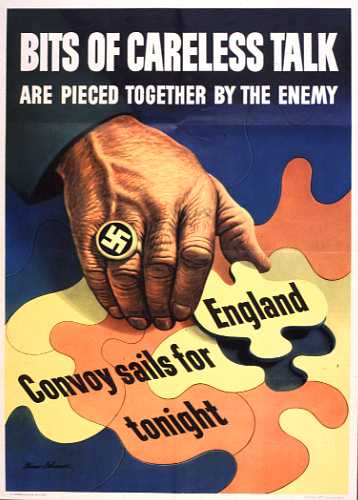 Having war correspondents certainly is not a perfect situation. Certain information that journalists can attain would be harmful if they were made public. For example, if a journalist saw soldiers gearing up for an assault in a particular forward operating base and mentioned it an article, the enemy nearby may be alerted that there will be an attack. A warned, prepared enemy will doubtlessly inflict more American casualties than an ignorant one. There are other tidbits of information, easily accessible to a civilian reporter, that could help American enemies, such as rationing, convoy movements, and even the general appearance and morale of the troops that could also be used to hurt American troops. As it is in the general interest of the American people to win the wars we fight with minimal casualties, it follows that it is in the general interest of the American people to restrict such speech.
"How is the world ruled and how do wars start? Diplomats tell lies to journalists and then believe what they read." (Karl Kraus)
However spotty the government's record on credibility may be, journalists have a somewhat murky record of their own. Famously, Judith Miller made recent headlines for her use of non-credible sources to make claims for Saddam's weapons of mass destruction arsenal in an article. In other word's: journalists have also been found to write in support of their own agenda. They can be just as misleading as the government.It can also be argued that war is no place for journalists, as Steven Vincent unfortunately found out in 2005 when he was captured and killed in Basra, Iraq. Journalists are not soldiers, and they certainly do not have training regarding combat a combat environment. So it seems foolish to allow them in a place as inherently dangerous as a war zone. The argument goes that journalists really can not expect protection and safety unless they play by the rules the government gives them.
I opine:
What it comes down to is that civilian journalists certainly have a constitutional right to go to a war zone and report what they see as long as they do not provably cause American troops harm by being there. It is also important to disqualify the argument for the journalist's safety. They are adults (consenting adults, even) and they can handle their lives and make their own choices as well as any of the civilian contractors that go to war alongside American troops.
But, importantly, there is also no constitutional demand for the military to cooperate with journalists. In fact, the current system of embedding journalists with military units goes far beyond any requirements on the government. Essentially, it is simply a wise move by the government in controlling what the media sees and tells. By allowing (or rather directing) reporters embedded in the midst of a unit, the government retains its control of what the public sees while creating an appearance of extended cooperation. It has not gone unchallenged. Embedding has drawn much criticism from some journalists. In a Daily Mirror article, Ameen Izzadeen has referred to it as "prostituted journalism." And I agree, to a point. Embedding has a few good points: safety, and being agreeable to both the government and many journalists. But what about to the American public? Embedding really just brings control of information output back to the government, and it leaves the public with essentially one source of information, and one that is not worthy of our trust.
Subscribe to:
Posts (Atom)