It is essential that the realities of a war, even if it is a popular war, be made available to the public. Wars, although they are now more directly controlled by the executive branch than ever, depend to a large extent on public opinion (or, rather, the effect that the peoples' opinion makes on their representatives). In any case, since the opinion of the people has some control over the war, it is essential that they be informed about the war.
In the debate about having civilian war correspondents, it is imperative to have a clear view of the alternative. Without war correspondents, the only source for information about the war is the military itself. Tactically, this is the best situation because it gives the military total control over what information is made public. Unfortunately, the government has lost the trust of many Americans. The Pentagon papers case in 1971, which revealed illegal actions by the US military years after the fact, is a good example of why many people do not believe that the government candidly acknowledges its own actions in war. According to a Pew study, trust in the American government is much lower now than it was in the 1960's.
The argument can be brought even to a more basic level than that- the legal, or constitutional level. In order to understand whether or not America should have war correspondents, we need to determine if there are more limits on free speech during times of war. Stanford Levinson notes that, "it is difficult to read our constitutional history . . . without believing that the Constitution is often reduced at best to a whisper during times of war." He notes Lincoln's suspension of habeas corpus during the American Civil War. This specific example does not really apply because the Constitution directly provides that "The privilege of the Writ of Habeas Corpus shall not be suspended, unless when in Cases of Rebellion . . . may require it." Interestingly, although there is nothing in the constitution that would change freedom of speech during wars, the Supreme Court has found such limits. Debs v. US decided that a certain American socialist leader named Eugene Debs was guilty for making an anti-war speech. The opinion reads: "the jury were most carefully instructed that they could not find the defendant guilty for advocacy of any of his opinions unless the words used had as their natural tendency and reasonably probable effect to obstruct the recruiting service." In other words, Debs is free to say whatever he believes as long as he says it in a way that no one can be influenced by it. The court essentially goes outside the bounds of the "clear and present danger" and "incitement" tests and restricts the ideas themselves. Fortunately, the court has looked on later free-speech in wartime cases in a more libertarian perspective, and far more potent anti-war statements than Debs' are now allowed, such as Michael Moore's movie Fahrenheit 911.
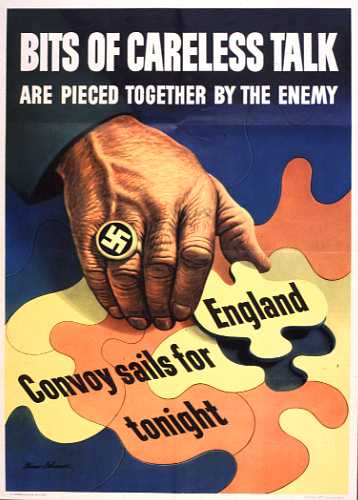 Having war correspondents certainly is not a perfect situation. Certain information that journalists can attain would be harmful if they were made public. For example, if a journalist saw soldiers gearing up for an assault in a particular forward operating base and mentioned it an article, the enemy nearby may be alerted that there will be an attack. A warned, prepared enemy will doubtlessly inflict more American casualties than an ignorant one. There are other tidbits of information, easily accessible to a civilian reporter, that could help American enemies, such as rationing, convoy movements, and even the general appearance and morale of the troops that could also be used to hurt American troops. As it is in the general interest of the American people to win the wars we fight with minimal casualties, it follows that it is in the general interest of the American people to restrict such speech.
"How is the world ruled and how do wars start? Diplomats tell lies to journalists and then believe what they read." (Karl Kraus)
However spotty the government's record on credibility may be, journalists have a somewhat murky record of their own. Famously, Judith Miller made recent headlines for her use of non-credible sources to make claims for Saddam's weapons of mass destruction arsenal in an article. In other word's: journalists have also been found to write in support of their own agenda. They can be just as misleading as the government.It can also be argued that war is no place for journalists, as Steven Vincent unfortunately found out in 2005 when he was captured and killed in Basra, Iraq. Journalists are not soldiers, and they certainly do not have training regarding combat a combat environment. So it seems foolish to allow them in a place as inherently dangerous as a war zone. The argument goes that journalists really can not expect protection and safety unless they play by the rules the government gives them.
I opine:
What it comes down to is that civilian journalists certainly have a constitutional right to go to a war zone and report what they see as long as they do not provably cause American troops harm by being there. It is also important to disqualify the argument for the journalist's safety. They are adults (consenting adults, even) and they can handle their lives and make their own choices as well as any of the civilian contractors that go to war alongside American troops.
But, importantly, there is also no constitutional demand for the military to cooperate with journalists. In fact, the current system of embedding journalists with military units goes far beyond any requirements on the government. Essentially, it is simply a wise move by the government in controlling what the media sees and tells. By allowing (or rather directing) reporters embedded in the midst of a unit, the government retains its control of what the public sees while creating an appearance of extended cooperation. It has not gone unchallenged. Embedding has drawn much criticism from some journalists. In a Daily Mirror article, Ameen Izzadeen has referred to it as "prostituted journalism." And I agree, to a point. Embedding has a few good points: safety, and being agreeable to both the government and many journalists. But what about to the American public? Embedding really just brings control of information output back to the government, and it leaves the public with essentially one source of information, and one that is not worthy of our trust.

2 comments:
This is an interesting topic, and I'll admit that I never stopped to consider that people were so very offended by the concept of journalists in warzone. After all, it IS their job, and while they might be assigned to go in the line of fire, who says they couldn't resign the position?
One thing that did cross my mind, however, was Daniel Pearl. I remember that ordeal, seeing it on the news, hearing about it, reading about it. It really disturbed and saddened me to think that a family lost a husband and father. But again, how is this different than a fallen soldier? I know that if I got a job as a journalist, I would not expect to undergo risks similar to that of a soldier. If I wanted to fight in a war, I would enlist to fight.
Laura:
You may find this article interesting.
Post a Comment